
If you have trouble watching this video, click here.
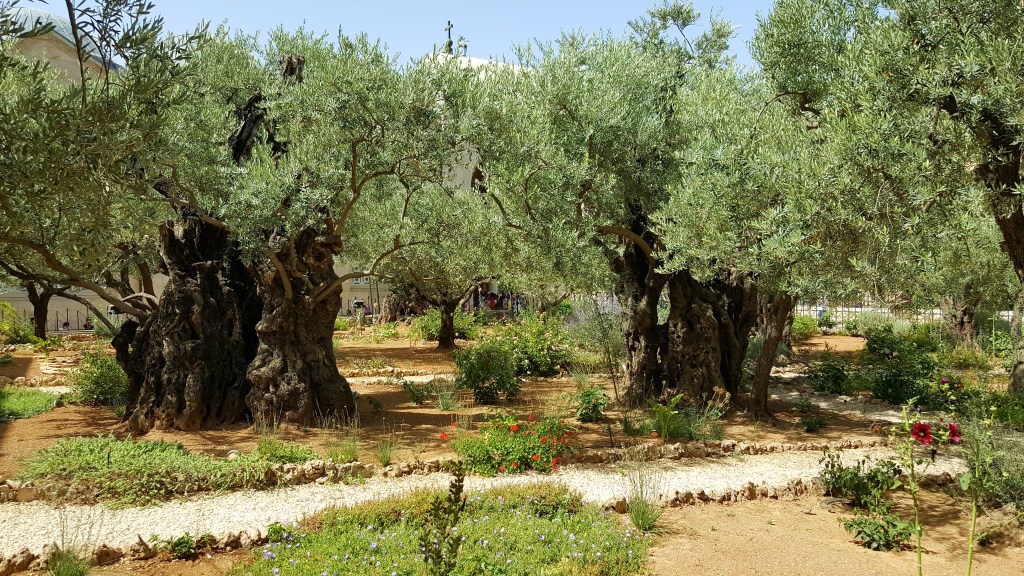
One of the cool things we got to see on our trip to Israel was the Garden of Gethsemane. It was at the foot of the Mount of Olives just outside of the Old City of Jerusalem. In the garden were several olive trees. The picture you see is one that I took of them. They were huge and were centuries old. These trees have survived droughts, earthquakes, and people taking parts of them because of the significance of where they’re planted. Even with all that, they still produce olives to this day.
In Psalm 52:8, David said, “But I am like an olive tree, thriving in the house of God. I will always trust in God’s unfailing love” (NLT). David understood that if he planted himself in God’s house, watered himself with God’s Word, and allowed himself to be cared for by God, he would thrive and produce fruit all the days of his life. He would be able to survive what life threw at him.
We all go through spiritual droughts, have our world shaken, and even have people pick us apart. The question is, “Where are you planted?” Are you planted in the fertile soil of God’s Word? If we want to thrive, even in the toughest times, we must plant ourselves, like David, in God’s house and trust in Him. He will care for you and cause you to keep producing long after everyone else thinks you’re done.
Throwback Thursday is a feature I’m using to help build some margin into my schedule to pursue other ventures. Each Thursday I’ll be bringing you a previously written devotional that still speaks encouragement to us from God’s Word.
Filed under Uncategorized

One of the first changes I had to make early on in starting this site was to change my definition of success. A few months in I went to a writers conference. The number one question people asked was, “How many subscribers do you have?” I was embarrassed to tell them 35. I had heard them sharing how they had several thousand. The next question that would get asked was, “How many clicks do you get a day?” On a good day I would get about ten. I became obsessed with those numbers and would allow them to ruin my day. I nit on,y began to measure my success by the numbers, I even began to measure my worth. It was t u til my wife gently reminded me thatIt wasn’t about the numbers. If God reached one person that day, it was successful.
In 1 Samuel 14, Saul had been appointed king of Israel recently. He began fighting the Philistines, but his army didn’t have swords. The Bible kept mentioning how many fighting men he had. Saul was camped under a pomegranate tree while trying to figure out how to get through a pass that was defended by the Philistines. His son Jonathan asked his armor bearer to walk with him. In verse 6, Jonathan said to his armor bearer, “Let’s cross over to the camp of those heathen Philistines. Maybe the Lord will help us; if he does, nothing can keep him from giving us the victory, no matter how few of us there are” (GNT). Jonathan understood that success wasn’t in his hands or in numbers. It was given and determined by God. He and the armor bearer fought the Philistine army and won a great battle that day through the Lord’s help.
What areas of your life are you feeling like a failure in right now? Are you measuring that by your definition of success or God’s? Chances are you’re looking at some form of numbers (bank account, sales, friends, etc.) to determine that. I heard someone recently say, “We measure what’s important to us, but are we measuring what’s important to God?” How we look at things matters and the enemy will twist our definition of success to make us feel down, unworthy, unsuccessful, un-you name it. In God’s economy, things work differently. Instead of asking Him to move whatever number you’re measuring, ask Him to move your perspective to see His idea of success. Ask Him to help you be content with what He number He deems a success. Once you change that, lots of things in your life will change and you’ll be satisfied knowing what matters to Him, matters to you.
Photo by Sebastian Voortman from Pexels
Filed under Uncategorized

There was a guy that I knew in my teens that I didn’t like much. He did things at other people’s expense, was cocky and rude. Then, about ten years ago, I got a friend request from him. I accepted it skeptically. He started posting ministry photos and such. In my heart I thought, “What’s his angle? Who is he trying to fool?” I questioned his motives every time I saw him talk about Jesus or a photo of the work He was doing for the Kingdom. I even showed my wife the photos and told her about him. As I was scoffing one night, the Holy Spirit spoke to me and asked, “Do I hold your past against you? How can you hold someone else’s past against them when I’ve forgiven them?” I had to let it go and forgive him. I even called him to discuss it with him and ask his forgiveness.
When I think of stories of someone forgiving a serious wrong, I think of Jacob and Esau in Genesis 32. Jacob stole his brothers blessing and took advantage of him in a desperate situation to get his birthright. Esau was so angry that he wanted to kill his brother. Jacob left town and disappeared for years. When it was time to come home, there was fear in the back of his mind about what Esau would do to him. Instead of being angry, Esau ran to embrace him. He had forgiven him long before, but never had the opportunity to express it. Jacob was still unsure and didn’t trust his brother, but ultimately accepted his forgiveness. I’m not sure when Esau decided to forgive Jacob, but when he did, a huge burden had to have been lifted.
Ephesians 4:32 instructs us, “But instead be kind and affectionate toward one another. Has God graciously forgiven you? Then graciously forgive one another in the depths of Christ’s love” (TPT). One of the hardest things we have to do as Christians is to forgive someone who wronged us. We’re not God so we can’t see their heart to see if they’ve changed, but even still we’re told to forgive as Christ has forgiven us. Forgiveness is truly a key that opens the door and releases us more than them. It may not restore the relationship (some don’t need to be reconciled), but it will open us up to allow God to repair the emotional scars that were left behind. It doesn’t happen right away, but the healing can’t begin in our own life until we forgive. If you’re struggling to forgive someone, ask God to help you with that. Forgiveness is His specialty.
Filed under Uncategorized

When I was a teen, we used to sing a Degarmo and Key song called, “Casual Christian”. The chorus went, “I don’t want to be a casual Christian. I don’t want to live, I don’t want to live a lukewarm life. ‘Cause I want to light up the night, with an everlasting light. I don’t want to live a casual Christian life.” Those words always resonated with me. As we would sing it, I would make it my prayer to give God my all. I didn’t want to be someone who went to church on Sunday, and lived like I wanted Monday through Saturday. I understood that it wasn’t by works that I was saved, but I didn’t want to live a life full of sin so that grace would abound. I wasn’t always sure what a casual Christian was, but that’s what I pictured in my head.
As I was reading the book of Ruth, I began to look at both Ruth and her sister in law Orpah. Naomi, who had been living in Moab because of a famine, decided to return to Israel after her husband and two sons had died. She and her two daughters in law were packed up when Naomi decided to tell them to stay. They all cried and both women decided to go with Naomi, but Naomi made one more plea. Orpah agreed to go back to her family, but Ruth insisted on going to Israel. In Ruth 1:16 she famously replied, “Don’t ask me to leave you and turn back. Wherever you go, I will go; wherever you live, I will live. Your people will be my people, and your God will be my God” (NLT). As I read that, I started to wonder if these two daughters in law represented a sold out Christian and a casual Christian.
Both wanted to go with Naomi, but one was enticed to stay where she was comfortable and felt at home. The other was willing to change everything about her life with an uncertain future. We don’t hear anymore out of Orpah, and we learn later that Ruth’s great grandson is King David. I believe God is calling us to live out our faith like Ruth. It’s time for us to make Him the number one priority in our life to the point we forsake all other things. We must learn to take up our cross daily, nail our own way of living to it and follow wherever He leads. If we’re going to turn this world upside down with the Gospel the way the apostles did, we’re going to have to quit being casual Christians. To make an impact, we must be totally and completely sold out to Him in how we live, love and act seven days a week. Jesus can’t just be our priority on Sunday.
Photo by Joshua Earle on Unsplash
Filed under Uncategorized

Every once in a while, I’ll see an equation pop up that looks something like 6-1(20+2)÷2=? for people to solve. I like to read the comments to see the heated exchanges of what people think the answer is. You can’t simply work this from left to right. You have to use the acronym PEMDAS (parentheses, exponents, multiplication, division, addition then subtraction) to do it. You can try any number of methods and come up with a lot of different answers, but only one answer is right. The only way to get it is to remember the acronym, “Please Excuse My Dear Aunt Sally,” and apply it.
Every one of us have problems that show up in our lives. Whether they are complicated or easy, we must approach them through the lens of Scripture. I can’t tell you how many times I’ve made things worse by trying to do it my way instead of God’s. The Bible gives us principles on how to live, how to handle your finances, how to treat others, how to act in a relationship and so much more. If we would apply those principles, we would be more successful in each of them.
2 Timothy 3:14 says, “But you must remain faithful to the things you have been taught” (NLT). Paul was reminding Timothy that it’s not enough to know the right way to do things. You must faithfully apply them. If you’re struggling in an area today, or going through a problem, I want to encourage you to see what God’s Word says about it. Take His Word and faithfully apply it to your situation. You’ll find that it is good for teaching us what is true, showing us what needs to be corrected in our lives and for training us in righteousness (verse 16).
Photo by Patrick Fore on Unsplash
Throwback Thursday is a feature I’m using to help build some margin into my schedule to pursue other ventures. Each Thursday I’ll be bringing you a previously written devotional that still speaks encouragement to us from God’s Word.
Filed under Uncategorized

I remember taking Driver’s Ed. There came a time in the class where we took the instruction and put it into practice by driving around. When it was my turn to log some hours, he had me drive on the freeway for a while. There were times when he had to hit the brakes on his side of the car because I wouldn’t go slower than the speed of traffic. When I went to change lanes, the instructor asked me what I needed to check after I turned on my blinker. I replied, “My rear view and side mirror.” He then asked, “What else?” I shrugged. He told me I needed to look over my shoulder as well to check my blind spot. If I change lanes and hit a car, it’s my fault because I should have checked my blind spots. I’ve never forgotten those instructions.
We all have blind spots in our lives, and we all need instruction and correction too, but not all of us invite it into our lives. In Exodus 18, Moses’ father in law had heard all of the great things Moses had done for his people, so he went to meet him. The next day he saw Moses judging the people and how inefficient it was. After asking a few questions about it, he said, “Moses’ father-in-law said to him in Exodus 18:17-18, “The thing that you are doing is not good. You will certainly wear out both yourself and these people who are with you, because the task is too heavy for you [to bear]; you cannot do it alone” (AMP). He gave Moses a better way to do it. Instead of responding, “I’m in charge here and don’t need your help,” Moses listened to the counsel, received the instructions and accepted the correction. How do you respond when someone does that to you?
Proverbs 19:20 says, “Listen to counsel, receive instruction, and accept correction, that you may be wise in the time to come.” Counsel is an outside perspective that helps guide us so we don’t hit things, or people, in our blind spots. Instruction is someone else telling us how do something we often think we know how to do. Correction is being told we’re in the wrong. All three are often hard to receive because of our pride. If we’re willing to put aside our pride, and invite these three things into our life with an open heart and mind, we will achieve far more than we ever could without it. We will also have better relationships with the people around us because we won’t be bumping into them in our blind spots as much. The key is for us to invite it into our lives or to accept it when someone else, including an in law, is offering it.
Photo by LinkedIn Sales Solutions on Unsplash
Filed under Uncategorized

There’s a saying that says, “Always leave them wanting more.” When teaching people this principle, I like to tell the story of something that happened a couple of years ago. I was riding with my friend in his truck on a rainy day. As we were going down the road, we saw a guy carrying a duffle bag walking on the shoulder. He was getting soaked and we thought the Christian thing to do was to pick him up. He put the duffle bag in the bed of the truck where it was still getting rained on, and climbed in the back seat. My buddy told him he could bring it inside, but he declined. As we we driving, he asked him what was in the bag. The man said sternly, “It’s none of your business!” Shocked, I said, “You don’t have to be rude about it. We just wanted to make sure it wasn’t going to get messed up.” He repeated himself with even more attitude. My buddy pulled the truck over and told him to get out. Before he could grab the bag, we sped off!
On the Sermon on the Mount, Jesus said, “Your lives are like salt among the people. But if you, like salt, become bland, how can your ‘saltiness’ be restored? Flavorless salt is good for nothing and will be thrown out and trampled on by others” (Matthew 5:13 TPT). Salt brings out incredible flavors in food, and it also makes you thirsty. If there’s too much, it makes the food inedible. If there’s too little, or you can’t taste it, what’s the point. The question my wife and I ask all the time is, “Did you leave them thirsting for more?” As people explore faith or are around us as Christians, that’s the question we have to ask. Did our conversation, and the way we acted, make them want to know more about God?
Colossians 4:5-6 says, “Live wisely among those who are not believers, and make the most of every opportunity. Let your conversation be gracious and attractive so that you will have the right response for everyone” (NLT). The word “attractive” means seasoned with salt. We need to make sure we’re interacting with people who don’t know Jesus so we can be salt and light. There’s little point to salt or light unless you’re around unseasoned people in the dark. Jesus didn’t spend all His time in the Temple or only with believers. He made a point to be among people who didn’t believe in God, taught them in ways they could understand and left them wanting more. We need to ask God daily for wisdom in how to live, speak and act in front of non-believers so that we make them thirsty to know more about Him. We will know it’s the right amount when they ask for more.
Photo by Jason Tuinstra on Unsplash
P.S. I know you’re dying to know what was in the bag, and it’s none of your business. 😉😂
Filed under Uncategorized

We live in a world where social media is driving people’s decisions. They count their worth by the number of likes they get. There’s such a burning desire and pressure to go viral that people will do anything to get noticed. As a society we’ve forgotten how to live in obscurity. We’ve forgotten that we can do things without having to record it for the rest of the world with a short video or picture. I’m not knocking social media. I use it too. I’m worried that we’re losing the abi,it’s to do things for God, others or ourselves without feeling the need to tell everyone about it. There are many great things done in secret that God rewards in secret, and many great things that have been done in public where we’ve received our reward. There are many people in the Bible who started in obscurity who went on to be famous, and some who remained in obscurity.
Gideon was trying to remain in obscurity. He was threshing wheat in the bottom of a wine press trying not to get noticed when the angel of the Lord showed up. After the angel called him a mighty man of valor, he to,d him that the Lord was with him and that he needed to go fight the Midianites. In Judges 6:15, Gideon replied, “But Lord, how can I rescue Israel? My clan is the weakest in the tribe of Manasseh, and I am the least important member of my family” (GNT). He was asking how could he do something so great since he was still in obscurity. The angel simply replied, “You can do it because I will help you.” He didn’t need to be famous or to go viral in order to do something amazing for God. He ended up going viral for following God’s plan for the battle, but it was born out of obedience and not a need to be famous.
Other people like the woman at the well did an amazing work for Jesus. She was able to tell her entire village about Jesus and to lead them to Him. The Bible doesn’t record her name. She remains in obscurity, but her work was no less valid or impactful. God doesn’t need us to go viral. He needs us to be obedient right where we are. When we’re ok with being obedient even if it means we won’t get “likes” or views or clicks, we open the door to God’s blessings (Matthew 6:1-4). When we are able to remain faithful in doing small things no matter what, He is able to trust us with greater things. We don’t have to go viral to make a significant impact on God’s Kingdom. In fact, most of the work done for God’s Kingdom is done in obscurity and unknown to others, but it is known by God and He blesses it and them. Ask God what you can be doing right now, right where you are, with what you have. Ask Him to help you make an impact even if it means no one will know.
Photo by C Technical from Pexels
Filed under Uncategorized


I was nominated by Lilkaraphael @ bisforblessed.com

I was nominated for this award by Mike Stephens at mikeforchrist.com
 Devotions by Chris Hendrix